|
The One Minute Manager
(1981) Kenneth Blanchard & Spencer Johnson A young man searches all over the world for an example of a great manager. He wants to work for one and learn how to become one. But most of the workplaces he has seen do not provide any great inspiration. He meets hard-nosed managers who get things done but who the staff do not much like, and nice managers who love their staff but do not pay enough attention to the bottom line. Could there exist a manager who combines the best qualities of each? He hears about someone who seems to fit the bill, ironically in a nearby town. To his surprise, this manager agrees to see him right away and to talk about how he manages his people. So begins the allegory of 'the one minute manager'. You are to be forgiven for being wary of a method of managing people which purports to only take one minute. Can it really work? Sales figures for this book suggest that: a) managers dream of spending less time on staff motivation and problems, and will grasp at anything which suggests a way out; or b) there must actually be something to this style of management. The way of the one minute manager There are three 'secrets' or elements to one minute management:
The second part of the story attempts to explain why one-minute management works. One minute goal setting works because "the number one motivator of people is feedback on results". We like to know how we are doing, and if we are doing well we feel good. The one minute manager has a plaque on his wall which reads: "Take a minute - Look at your goals - Look at your performance - See if your behavior matches your goals". Simple but effective. One minute praisings are also effective for motivational reasons. It is rare to find someone who can know how to do everything well from day one; you have to put some effort into training. "So the key to training someone to do a new task is, in the beginning, to catch them doing something approximately right until they can eventually learn to do it exactly right." Not discipline, only encouragement works with people who are not secure in what they are doing. Praise gets them moving in the right direction. Though it need take up very little time, praise is the fuel which can drive a whole enterprise. One minute reprimands work because they are the fairest form of feedback for correcting below-par performance. Because goals have been set and expectations are so transparent, the person will usually see when the reprimand is fair. The manager is respected because he has "spoken the simple truth". As the reprimand is quick and focused on specific action (not the person themselves), there is less bad feeling; when the encounter is over it always ends on a good note and can be soon forgotten or even made light of. Managing to lead The very simplicity of one-minute management will deem it suspect in the eyes of some, yet it is little more than the application of efficiency to workplace interpersonal relations. The philosophy of "taking very little time to get big results" comes from a nuts-and-bolts appreciation of human nature. The story's one minute manager admits that management cannot always be performed in a minute. It is more a symbol of the idea that managing people can be much less complicated that we think. There's no for need endless sessions to discuss objectives and problems. Some time needs to be invested to establish goals, but after that the contact between boss and subordinate can be minimal. Consider some successful examples of this way of managing people. Investor Warren Buffett employs business managers whose small number of objectives are so clear that he rarely needs to meet with them. They get on with the job and send him periodic reports. Antarctic explorer Sir Ernest Shackleton was so respected by his crew members because they knew exactly what was expected of them; if reprimanded for anything, there was always a clear and rational reason why. More recently, GE boss Jack Welch explained his management style as "kicks and hugs", which were meted out or given only according to strictly outlined, previously mapped-out goals. This did not create a climate of fear - if a person did not measure up they could blame no one but themselves. One further thought: the ideas in this book are not just for the work environment; they can apply to many areas of personal relations. To be "tough and nice", for instance, should be the goal of any parent. Final word After decades of weighty tomes on management science and organizational behaviour, this book came as a breath of fresh air for managers. It may seem simplistic, but was firmly based on the latest findings in behavioural psychology. Blanchard & Johnson's genius was to dress up this knowledge in the more attractive form of a story. With today's flatter organizational structures and emphasis on working in teams, it could be argued that The One Minute Manager is less relevant. The model seems to express an older hierarchical model of the workplace - "the boss and his subordinates". What's more, today we enjoy making the distinction between mere managers and leaders - while the latter inspires, the former simply, well, manages. Yet a true leader will find it difficult to get anywhere without some basic people management skills. He or she will seek to create relaxed workplaces in which people have all the time they need to pursue important goals. This sense of relaxed purpose arises because everyone knows exactly what their role is; there is both transparency and clarity of purpose. |
"As he sat at his desk thinking, the new One Minute Manager realized what a fortunate individual he was. He had given himself the gift of getting greater results in less time." Kenneth Blanchard & Spencer Johnson Blanchard has a BA from Cornell University in Government and Philosophy, an MA from Colgate University in Sociology and Counselling, and has a PhD in Administration and Management. He is professor of leadership and organizational behavior at University of Massachusetts, Amherst, and runs his own corporate training and development company. Johnson has a background in medicine, with a BA in psychology from the University of Southern California, and his MD degree from the Royal College of Surgeons. He has been Medical Director of Communications for Medtronic, which invented heart pacemakers, a research physician at The Institute for Inter-disciplinary Studies (a think tank) and a consultant to the University of Southern California's School of Medicine. Over a million copies of The One Minute Manager are in print. Its success has spawned spin-off titles including Leadership and the One Minute Manager, The One Minute Sales Person and Putting the One Minute Manager to Work. |
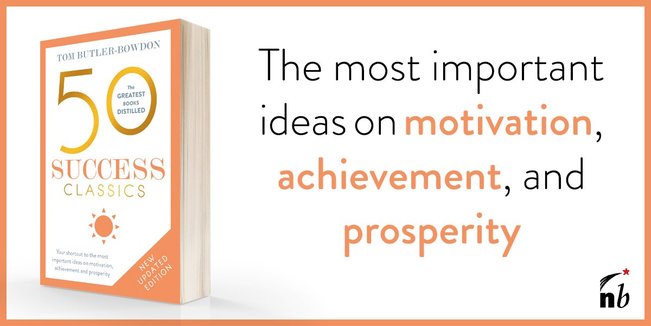
Source: 50 Success Classics: Your Shortcut to the Most Important Ideas on Motivation, Achievement, and Prosperity (published by Nicholas Brealey/Hachette, London & Boston).
Click for reader reviews